





Office-appropriate socks are defined by four criteria: length, colour coordination with trousers, pattern subtlety, and fabric quality. Get any one of these wrong and even a well-pressed suit loses its authority. The role of socks in work attire is more significant than most professionals realise. They create a visual bridge between trouser hem and shoe, and that bridge either holds the outfit together or breaks it. Merino wool and long-staple cotton are the gold-standard materials for dress socks, and over-the-calf length is the benchmark for formal business settings.
What makes socks office-appropriate?
Office-appropriate dress socks must create a seamless visual extension of the trouser leg. The moment a sock draws attention to itself, whether through a flash of bare skin, a garish pattern, or a sagging elastic, it undermines the entire outfit. The industry term for this category is “dress socks,” and it covers a specific set of standards for length, colour, pattern, and construction.
The minimum acceptable length for business casual environments is mid-calf. For formal business wear and high-stakes meetings, over-the-calf socks are mandatory. They guarantee no skin is exposed when you sit down or cross your legs, which is the single most common sock-related style error in office settings.
Colour matching follows one clear rule: match the sock to the trouser, not the shoe. Trouser colour matching elongates the leg line and creates a continuous visual flow from waist to floor. Matching to the shoe instead creates a visual break at the ankle that shortens the silhouette.

Pattern must be subtle. Pin dots, birdseye weaves, and fine ribs are all acceptable in professional environments. The test is simple: if you can identify the pattern from across the room, it is too bold for the office.
How does sock length affect professionalism?
Sock length is the most technically important factor in office dress. A sock that slides down or exposes skin at the shin signals poor attention to detail, regardless of how expensive the rest of the outfit is.
Over-the-calf socks solve this problem entirely. They sit above the calf muscle and stay in place throughout the day without assistance. Modern over-the-calf socks with quality elastane content stay up all day, making sock garters completely obsolete. A small percentage of elastane, typically in the range of 1–3%, provides the tension needed without constricting the leg.
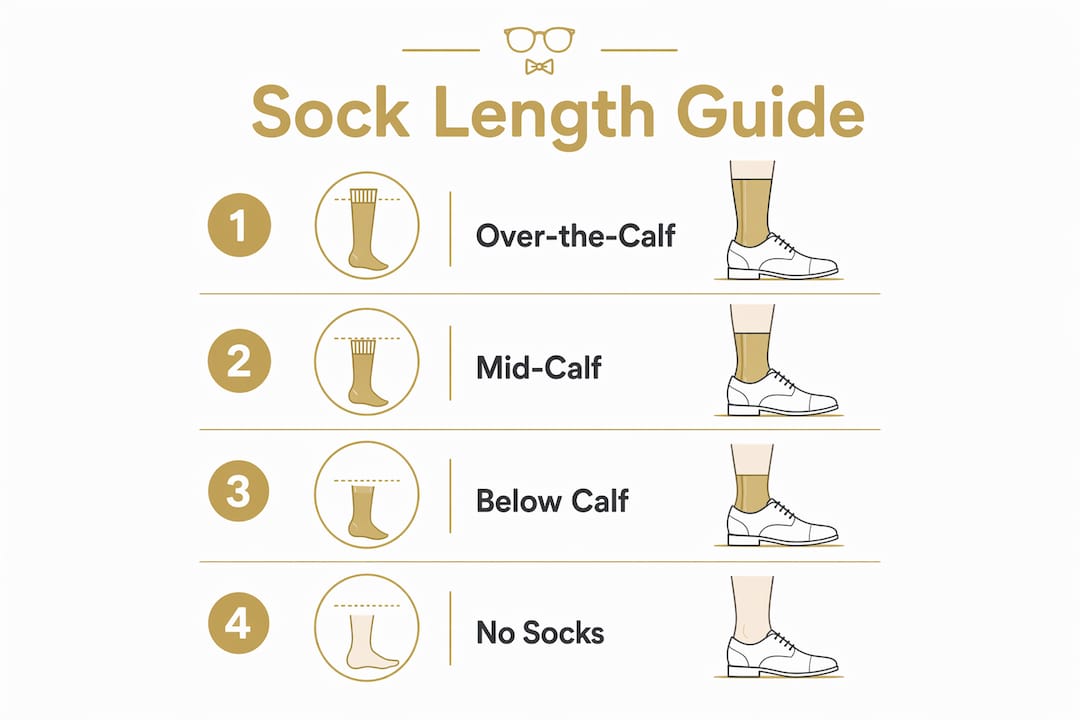
Mid-calf socks are the minimum for business casual environments. They work well when you are standing but can slip below the calf when seated for long periods. Socks labelled “calf length” are often shorter than advertised and prone to sliding down, which is a known pitfall when buying without trying.
Crew socks and no-show socks are not suitable for formal office wear. They belong in casual or athletic contexts. Wearing them with dress trousers and leather shoes is a clear dress code violation.
Here is a quick reference for length by dress code:
- Black tie or formal business: Over-the-calf only
- Standard office business wear: Over-the-calf preferred, mid-calf acceptable
- Business casual: Mid-calf minimum
- Smart casual (e.g. loafers without socks): No-show liner socks only, never bare feet in formal shoes
Pro Tip: Buy over-the-calf socks with a clearly stated elastane percentage. If the label does not specify, the elastic is likely to fail within a few months of regular wear.
How do colour and pattern affect office sock choices?
Colour is the most visible element of a dress sock, and it carries the most risk. The safest approach is to match the sock precisely to the trouser colour. Navy trousers pair with navy socks. Charcoal trousers pair with charcoal or dark grey socks. This creates the elongated leg line that style experts consistently recommend.
Charcoal socks are the single most versatile neutral in a professional wardrobe. They work across navy, grey, and even mid-brown trousers without clashing. For high-stakes meetings where you want your outfit to be entirely beyond reproach, charcoal is the correct choice.
Solid colours are always the safest option. Subtle tonal patterns are acceptable when the rest of the outfit is well controlled. The key word is “tonal.” A navy sock with a dark blue birdseye pattern reads as solid from a distance. A navy sock with a bright red polka dot does not. Socks should serve as an accent only when every other element of the outfit is already working together.
Pro Tip: Build your office sock wardrobe around three solid colours that match your most-worn trousers. Add one subtle patterned pair only after the solid foundation is in place.
The table below shows how to match sock colour to common office trouser colours.
| Trouser colour | Recommended sock colour | Pattern guidance |
|---|---|---|
| Charcoal grey | Charcoal or dark grey | Solid or fine rib |
| Navy | Navy or dark navy | Solid or pin dot |
| Mid grey | Mid to dark grey | Solid only |
| Black | Black | Solid only |
| Brown or tan | Dark brown or tan | Solid or birdseye |
What materials make dress socks suitable for the office?
Fabric choice determines how a dress sock performs across a full working day. The wrong material causes overheating, odour, and discomfort by mid-afternoon. The right material keeps the foot dry, the sock in shape, and the wearer comfortable from morning to evening.
Merino wool is the best overall fabric for dress socks. It wicks moisture away from the skin, regulates temperature in both warm and cool conditions, and resists odour naturally. It also holds its shape well over repeated washes, which matters for longevity. For professionals who want to understand more about breathable work sock fabrics, merino wool consistently outperforms alternatives in real-world office conditions.
Long-staple cotton is the best alternative to merino wool. It is softer against the skin, highly breathable, and more affordable. It does not regulate temperature as effectively as merino, but it performs well in climate-controlled office environments. Bamboo viscose is also recommended for breathability, though it is less durable than either merino or long-staple cotton.
Two fabrics to avoid in dress socks are 100% cotton and 100% polyester. Pure cotton retains moisture rather than wicking it, which leads to discomfort and odour over a long day. Pure polyester traps heat and has no natural breathability. Both are common in budget socks and both underperform in office conditions.
Key fabric guidelines for office dress socks:
- Merino wool: Best for temperature regulation, moisture-wicking, and durability
- Long-staple cotton: Best for softness and breathability in controlled environments
- Bamboo viscose: Good breathability, lower durability
- Elastane (1–3%): Adds stretch and helps socks retain their shape
- Avoid: 100% cotton, 100% polyester, and thick cushioned footbeds
Fabric thickness also affects shoe fit. A thicker sock changes the internal volume of a dress shoe. For slim-cut Oxford or Derby shoes, a finer gauge sock in merino or long-staple cotton is the correct choice. Thicker socks belong in boots or more casual footwear.
Common mistakes that undermine office sock choices
Even professionals with strong overall style make predictable errors with socks. These mistakes are avoidable once you know what to look for.
-
Wearing sports or athletic socks with dress shoes. This is the most common error. Athletic socks have thick cushioning, visible branding, and a casual construction that clashes with leather shoes and tailored trousers. The contrast is immediately noticeable.
-
Choosing the wrong length for the occasion. Mid-calf socks at a formal board meeting, or crew socks at any business setting, signal a lack of awareness of dress codes. Match the sock length to the formality of the event.
-
Selecting socks with colourful or cushioned footbeds. The full sock, including the footbed, must be uniformly professional in formal settings. When you sit down and cross your legs, the underside of the sock becomes visible. A bright yellow or heavily cushioned footbed on an otherwise dark sock is a detail that colleagues will notice.
-
Going sockless with formal shoes. Going sockless with formal lace-up shoes is a stylistic error and damages the shoe interior over time. If you prefer the sockless look with loafers in warmer months, no-show liner socks are the correct solution. They protect the shoe and prevent discomfort without being visible.
-
Clashing colours or patterns with the outfit. A bold patterned sock worn with a patterned shirt and a patterned tie creates visual noise. Patterns work only when the rest of the outfit is solid or very restrained.
Key takeaways
Office-appropriate dress socks require over-the-calf length, trouser-matched colour, subtle or solid patterns, and breathable fabrics such as merino wool or long-staple cotton.
| Point | Details |
|---|---|
| Sock length is non-negotiable | Over-the-calf is the standard for formal office wear; mid-calf is the minimum for business casual. |
| Match socks to trousers, not shoes | Trouser colour matching creates a continuous leg line and a more polished silhouette. |
| Patterns must pass the distance test | If a pattern is visible from across the room, it is too bold for a professional setting. |
| Merino wool outperforms all alternatives | It wicks moisture, regulates temperature, and holds its shape better than cotton or synthetic fabrics. |
| The full sock must be professional | Colourful or cushioned footbeds become visible when seated and undermine formal dress codes. |
Why I think most professionals underestimate their socks
Socks are the last thing most professionals think about when dressing for the office, and that is precisely why they reveal so much. I have sat across from senior executives in otherwise impeccable suits and noticed the moment they crossed their legs. A flash of bare shin, a sagging mid-calf sock, or a novelty pattern that belonged on a weekend walk. None of it was intentional. All of it was avoidable.
The trouser-matching rule is the single most underused piece of style advice in office dressing. Most professionals default to matching their socks to their shoes, which is the wrong anchor point. Matching to the trouser creates a visual line that makes you look taller and more put-together. It is a small change with a disproportionate effect on how an outfit reads.
My honest recommendation is to invest in a small number of high-quality pairs rather than a large number of mediocre ones. Six pairs of well-made merino wool socks in charcoal, navy, and black will serve you better than twenty pairs of budget cotton socks that lose their shape within a month. A professional sock wardrobe built on quality and versatility is a one-time investment that pays back in comfort and confidence every working day.
Maintenance matters too. Wash dress socks inside out on a gentle cycle and air dry them. Heat from a tumble dryer degrades elastane and shortens the life of the sock significantly. Treat them well and a good pair of merino socks will last years.
— Amanda
Sock Geeks: dress socks built for the office
Sock Geeks sources merino wool and long-staple cotton dress socks designed to meet the exact standards covered in this guide. Every pair is built for full-day comfort, with over-the-calf options, solid colours, and subtle tonal patterns that work across formal and business casual dress codes.

Whether you are refreshing your work wardrobe or building a professional sock collection from scratch, Sock Geeks offers a curated range that takes the guesswork out of office dressing. With a 4.72 customer rating and a focus on ethically sourced materials, Sock Geeks delivers quality you can rely on from monday morning to friday afternoon. Browse the full range at Sock Geeks and find the right pair for your workplace.
FAQ
What length of sock is correct for formal office wear?
Over-the-calf socks are the correct choice for formal business settings. They prevent skin exposure when seated and stay in place throughout the day without slipping.
Should I match my socks to my trousers or my shoes?
Match your socks to your trousers. Trouser colour matching creates a continuous leg line that elongates the silhouette, which is the approach recommended by professional style guides.
Are colourful socks professional in an office environment?
Subtle tonal patterns and solid colours are professional. Bold or novelty patterns are appropriate only in casual settings. If a pattern is identifiable from across the room, it does not belong in a formal office.
What is the best fabric for office dress socks?
Merino wool is the best fabric for dress socks. It wicks moisture, regulates temperature, and resists odour, making it well suited to long working days in office environments.
Can I go sockless with dress shoes at the office?
Going sockless with formal lace-up shoes is a stylistic error and damages the shoe interior over time. If you prefer the sockless look with loafers in a business casual setting, wear no-show liner socks to protect both your comfort and your shoes.



Leave a comment